


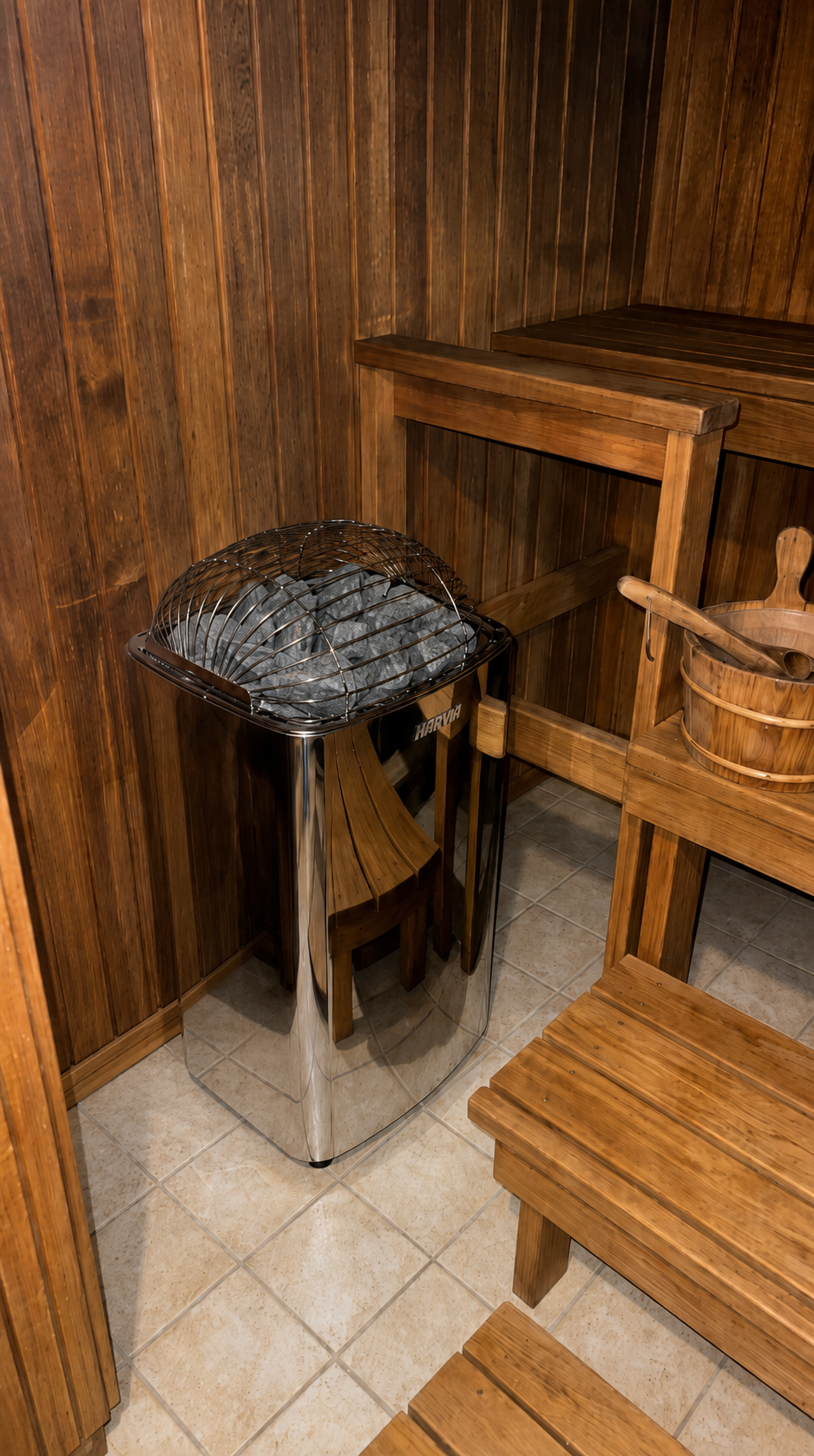
Sauna Heater Comparison
HUUM and Harvia both make high-quality sauna heaters, but they create different bathing experiences. This comparison explains which brand is better for soft löyly, faster heating, smart controls, small rooms, outdoor saunas, and large stone capacity.
By Ryan Williams, Sauna Expert | June 2, 2026 | Reviewed for product specifications and sauna-fit guidance

HUUM typically emphasizes large stone capacity and sculptural design, while Harvia offers a broader range of heater styles and steam experiences.
Quick answer: HUUM vs. Harvia
HUUM generally has the advantage for soft, long-lasting traditional löyly because many HUUM sauna heaters hold a large volume of stones. Harvia often has the advantage for faster warm-up, broader model selection, and more ways to manage heat and humidity, including Virta Combi models with an integrated steamer.
Performance depends more on the specific model than the brand. A high-capacity Harvia Cilindro can produce softer steam than a smaller HUUM model, while a HUUM Hive can deliver a much deeper stone-driven steam experience than a lower-capacity Harvia heater. Compare our Harvia sauna heaters by model, power output, and control requirements.
Best for softer löyly
HUUM, especially Drop, Hive Mini, Hive, Cliff, and Steel models with large stone loads.
Best for faster sessions
Harvia models with smaller stone loads, such as Kip, generally require less thermal mass to heat.
Best for humidity control
Harvia Virta Combi, because it adds an integrated steamer rather than relying only on water poured over stones.
In this comparison
HUUM vs. Harvia sauna heaters at a glance
Quick comparison of the factors that affect everyday sauna use
| Factor | HUUM | Harvia | Practical advantage |
|---|---|---|---|
| Traditional steam character | Usually softer, fuller, and longer-lasting because many models use large open stone baskets. | Varies widely by model, from sharp bursts in compact heaters to soft steam from Cilindro. | HUUM for gentle stone-driven löyly. Harvia for greater variety. |
| Stone capacity examples | Drop about 122 lb, Hive Mini about 330 lb, Hive about 529 lb in the current air-tunnel configuration. | Kip about 50 lb, Club about 132 lb, Cilindro models vary and can reach 264 lb in the PC110E package. | Depends on the exact model, not only the brand. |
| Warm-up behavior | High-stone models can take longer because more thermal mass must be heated. | Lower-stone models often warm faster. High-capacity Harvia models can also require more time. | Harvia for quick sessions, HUUM for planned preheating and heat retention. |
| Wi-Fi controls | UKU Wi-Fi with the HUUM mobile app, scheduling, remote start, and multiple control-panel styles. | Xenio or Fenix controls with MyHarvia connectivity on compatible systems. | Both are capable. Interface preference is subjective. |
| Humidity options | Traditional water-on-stones löyly is the main approach. | Traditional heaters plus Virta Combi models with an integrated steamer. | Harvia for controlled humidity beyond manual water pouring. |
| Design | Sculptural, stone-forward, modern Nordic appearance. | Traditional, minimalist, pillar-style, and premium design options across a large range. | HUUM for a visual focal point. Harvia for more design choices. |
| Best fit | Buyers who prioritize soft löyly, visible stones, and modern design. | Buyers who prioritize range, value, faster heating, or specialized steam control. | Match the heater to the room and bathing style. |
Which heater produces better steam?

The answer changes depending on whether “more steam” means softer traditional löyly or more precise humidity control.
For soft, continuous traditional löyly, HUUM generally has the edge. Its open-basket heaters expose a large volume of hot stones, so water can spread across more heated surface area and evaporate gradually.
For adjustable humidity, Harvia has the edge when a Virta Combi model is included in the comparison. The integrated steamer can maintain humidity in a way that a standard water-on-stones heater cannot reproduce.
That distinction is important. “More steam” can describe three different things:
- Steam volume: How much water can be vaporized before the stones need to recover.
- Steam character: Whether the löyly feels soft and enveloping or sharp and immediate.
- Humidity control: Whether humidity is created manually by pouring water or regulated by an integrated steamer.
“When customers say they want better steam, I first ask what they mean. Some want a gentle wave of löyly that lingers, while others want fast heat or steady humidity. The correct heater can be very different for each of those goals.”
Ryan Williams, Sauna Expert at SaunaHeaters.com
How stone capacity changes the löyly experience

Large stone baskets create more heated surface area for water and store more thermal energy.
Stone capacity is one of the most useful first filters when comparing sauna heaters. A larger stone mass stores more heat and gives water more hot surface area to contact. The result is often a softer, more gradual steam release.
A smaller stone load can heat more quickly and create a strong burst when water is poured, but the stones may need more time to recover between pours. Neither experience is automatically better. The right choice depends on how you use the sauna.
Choose more stone mass when you want:
- Longer, gentler sauna sessions
- Soft and enveloping löyly
- More heat retention between pours
- A heater that displays a large volume of natural stone
Choose less stone mass when you want:
- Faster preheating
- Shorter, more spontaneous sessions
- Sharper and more immediate steam bursts
- A compact heater with a lower installed cost
HUUM's approach to steam
HUUM designs many of its heaters around large, open stone baskets. The HUUM Drop is wall-mounted and holds about 122 lb of stones. The HUUM Hive is built for larger rooms and holds about 529 lb in its current air-tunnel configuration. HIVE Mini sits between those models at about 330 lb.
This stone-forward design is why HUUM is often associated with gentle, long-lasting steam and a stable bathing environment during longer sessions.
Harvia's approach to steam
Harvia offers a broader range of heater styles. The compact Kip uses a relatively small stone load and is designed for straightforward, efficient heating. The Harvia Cilindro uses a tall open stone column that lets bathers change the steam character by pouring water on the side or top. The Virta Combi adds an integrated steamer for users who want more consistent humidity.
Harvia's advantage is not one single steam profile. It is the ability to select from very different heater formats based on room size, budget, usage frequency, and preferred humidity.
Stone selection and placement still matter
Even an excellent heater can produce disappointing steam when the stones are worn, undersized, packed too tightly, or stacked incorrectly. Follow the manufacturer's stone-size and loading instructions, use stones intended for sauna heaters, and inspect them regularly for cracking or deterioration.
Heat-up time and operating temperature
Harvia often feels faster when comparing a compact, lower-stone heater with a high-capacity HUUM model. The reason is thermal mass. Heating 50 lb of stones generally requires less time than heating 122, 330, or 529 lb.
That does not mean every Harvia warms faster than every HUUM. A heater's kW output, room volume, insulation, glass area, ventilation, ceiling height, outdoor temperature, and sensor location can all change warm-up performance.
For HUUM owners, scheduling can largely remove the inconvenience of a longer preheat. The UKU Wi-Fi controller and HUUM app allow the heater to begin warming before the session. Compatible Harvia systems offer remote operation and scheduling through Xenio or Fenix controls and the MyHarvia app.
Temperature limits require context
North American Harvia Xenio packages commonly list a control range up to 194°F. The current North American HUUM UKU manual allows a maximum set temperature of 230°F when only the required safety sensor is used, and 194°F when the optional bench sensor is installed. These numbers are controller settings measured at sensor locations, not a guarantee of the temperature a bather will feel at bench height.
Controls, build quality, and design

Both brands offer durable electric heaters, but the visual and control experience differs across their lineups.
Smart controls
HUUM's UKU platform is closely integrated with the HUUM app and is offered with several control-panel finishes. Harvia supports connected operation through compatible Xenio and Fenix controls using MyHarvia. Both ecosystems can support remote preheating, but compatibility depends on the heater and control package selected.
Rather than declaring one app universally better, compare the exact package, required safety devices, installation location, scheduling functions, and control-panel style.
Build quality and serviceability
Both brands use sauna-appropriate metal construction and offer replacement parts. Harvia has a longer manufacturing history and a broad installed base in North America. HUUM is newer and has built its reputation around stone-forward designs, Estonian manufacturing, and award-winning products such as Drop and UKU.
Long-term reliability depends heavily on correct electrical installation, ventilation, stone maintenance, heater sizing, and avoiding repeated operation with deteriorated or improperly loaded stones.
Design
HUUM heaters are often selected as a visual centerpiece. Drop resembles a water droplet, while Hive emphasizes a large natural stone mass. Harvia ranges from traditional wall-mounted designs such as Kip to pillar heaters such as Cilindro and premium modern units such as Spirit and Virta.
Choose HUUM when you want the heater to define the room visually. Choose Harvia when you want a wider selection of traditional, understated, pillar-style, and specialty designs.
Head-to-head model matchups

Brand-level comparisons are useful, but model-to-model comparisons lead to better buying decisions.
HUUM Drop
- Wall-mounted design that keeps floor space open
- About 122 lb of stones
- Strong fit for modern small and midsize sauna rooms
- Soft steam for a wall-mounted heater
Harvia Cilindro
- Floor-standing pillar design
- Large stone capacity that varies by model
- Water can be poured on the side or top to change the steam intensity
- Requires more floor space than Drop
Drop vs. Cilindro verdict: Choose HUUM Drop when saving floor space and achieving a modern wall-mounted look are priorities. Choose Harvia Cilindro when you want a larger stone column and more control over where water contacts the stones.
HUUM Hive
- Built for large residential and commercial-size sauna rooms
- About 529 lb of stones in the current configuration
- Exceptionally soft, gradual, and long-lasting löyly
- High initial cost and significant installed stone weight
Harvia Club
- Commercial-grade floor-standing heater
- About 132 lb of stones in the K10G model
- Designed for reliable heating and frequent use
- Lower stone weight and generally lower installed cost than Hive
Hive vs. Club verdict: Choose HUUM Hive when refined stone-driven löyly is the main goal and the room can benefit from its thermal mass. Choose Harvia Club when reliability, quicker recovery, commercial use, and value are more important.
Which brand is best for your sauna?

The best choice starts with room size and usage, then narrows by steam preference, controls, design, and budget.
Best for soft traditional löyly
HUUM, particularly models with high stone capacity.
Best for fast, spontaneous sessions
Harvia, particularly compact models with smaller stone loads.
Best for a small sauna
Either brand can work. Compare the appropriately sized Drop, Steel Mini, Cliff Mini, Kip, Spirit, or Cilindro model.
Best for an outdoor sauna
Neither brand wins automatically. Account for cold weather, glass, insulation, and adjusted room volume before comparing models.
Best for controlled humidity
Harvia Virta Combi because it includes an integrated steamer.
Best modern focal-point design
HUUM, especially Drop and Hive.
Best broad model selection
Harvia, with compact, pillar, heavy-duty, combination, and commercial options.
Best for a large room and maximum stone mass
HUUM Hive when the sauna size and installation can support it.
How to choose between HUUM and Harvia
“The most common mistake is deciding on a brand before confirming the adjusted room size and electrical setup. Once those two items are correct, the choice between steam character, heating speed, and design becomes much clearer.”
Ryan Williams, Sauna Expert at SaunaHeaters.com
Final verdict
Choose HUUM when soft, long-lasting löyly, large stone capacity, and a modern stone-forward design are your top priorities.
Choose Harvia when faster heating, wider model selection, traditional Finnish design, commercial-duty options, or integrated humidity control matter more.
Both brands offer distinct advantages, so the better choice varies by user. The strongest buying decision comes from comparing properly sized models with similar power output, then evaluating stone capacity, warm-up behavior, controls, clearances, and total installed cost.
Frequently asked questions
Is HUUM better than Harvia?
No brand is better in every situation. HUUM is often the stronger choice for soft stone-driven löyly and sculptural design. Harvia is often the stronger choice for model variety, faster-heating compact heaters, commercial options, and Combi models with integrated humidity.
Which brand makes better steam?
HUUM generally produces softer, longer-lasting traditional löyly because many of its heaters hold more stones. Harvia Cilindro can also create excellent soft steam, while Harvia Virta Combi provides more direct humidity control through an integrated steamer.
Which sauna heater holds the most stones?
Among the models discussed here, the current HUUM Hive configuration holds about 529 lb of stones. Hive Mini holds about 330 lb, HUUM Drop about 122 lb, Harvia Club K10G about 132 lb, and Harvia Cilindro capacity varies by model and package.
Does a larger stone capacity always mean better steam?
Not necessarily. More stones usually support softer and longer-lasting steam, but heater output, room sizing, stone condition, loading method, ventilation, and water-pouring technique also affect the result.
Which brand heats faster?
Harvia often heats faster when a compact model with fewer stones is compared with a high-capacity HUUM heater.
A fair comparison must account for kW output, adjusted room volume, insulation, glass area, ambient temperature, and stone mass.
Can you get soft steam from a Harvia heater?
Yes. Harvia Cilindro uses a large open stone column and can create gentle steam when water is poured along the side. Harvia Spirit also emphasizes soft steam, and Virta Combi can maintain humidity with an integrated steamer.
Which is better for a small sauna room?
Both brands have suitable options. Compare models sized for the same adjusted room volume, then check clearances. HUUM Drop and Mini models are attractive when soft steam and modern design matter. Harvia Kip and other compact models are practical when fast heating and value matter.
Which is better for an outdoor sauna?
Outdoor saunas may require additional capacity because of cold ambient temperatures, glass, and heat loss. HUUM can be attractive for soft steam and heat retention, while Harvia can be attractive for faster warm-up and broader budget options.
Do HUUM and Harvia offer Wi-Fi controls?
Yes, on compatible systems. HUUM uses the UKU platform and the HUUM app. Harvia offers connected operation through compatible Xenio and Fenix controls with the MyHarvia app. Confirm that the control package is approved for the exact heater.
Need help choosing the right heater?
Send us your sauna's interior dimensions, ceiling height, glass area, indoor or outdoor location, and preferred steam experience. Our team can compare properly sized HUUM and Harvia models for your project.