


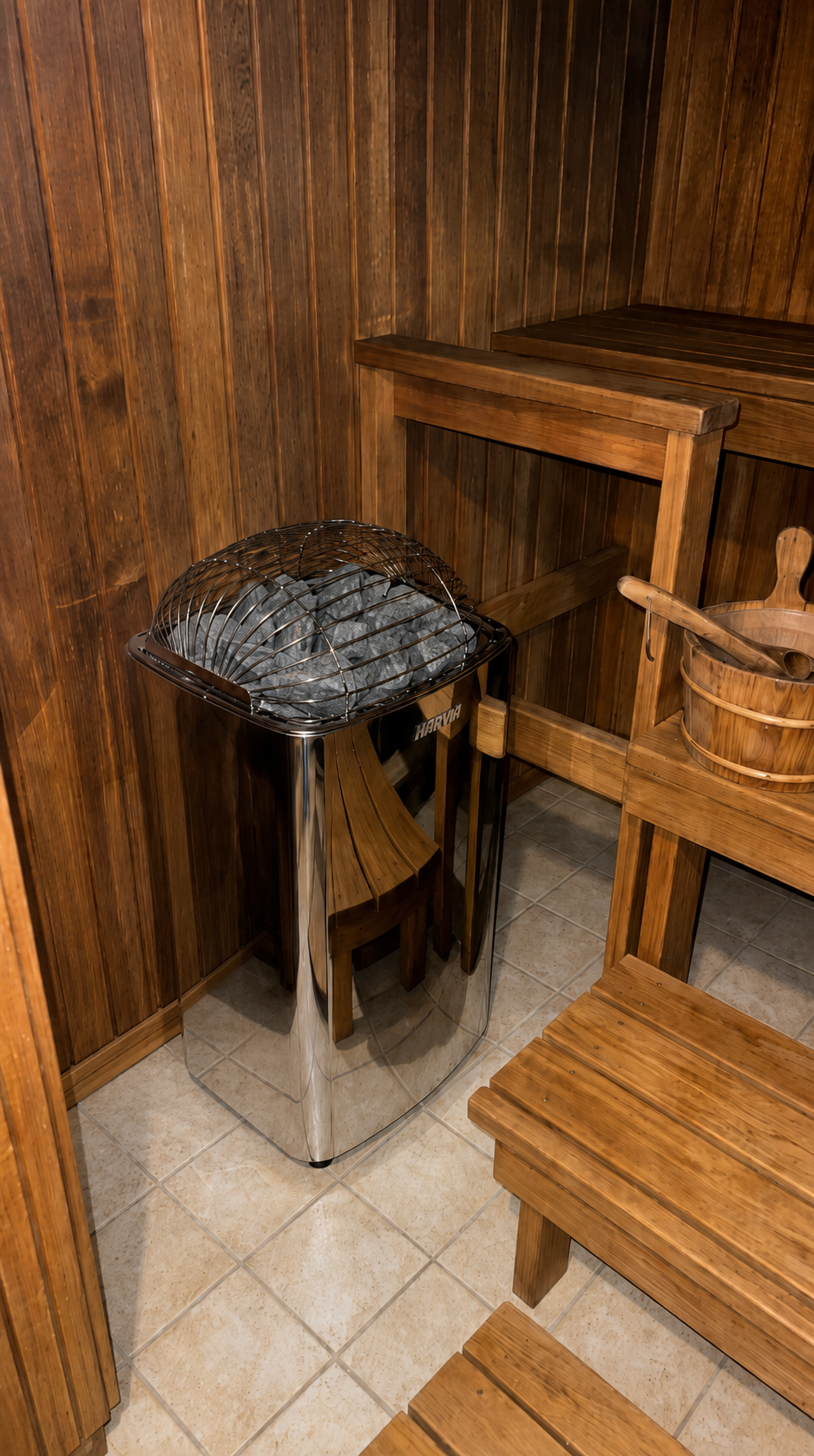
Sauna Heater Buying Guide
A practical guide to electric, wood-burning, gas, and combi sauna heaters, including sizing, temperature considerations, residential vs. commercial applications, and the factors that determine the right heater for your space.
By John Funk, Sauna Expert and YouTube Lead | Originally published July 16, 2026

Quick answer: Which type of sauna heater is best?
For a residential sauna setup, an electric sauna heater offers a practical balance of dependable heating, user-friendly controls, easy maintenance, and quick preheating. Wood-burning heaters suit users looking for a more traditional sauna experience or a reliable option for locations without easy access to electricity. Gas heaters are a niche option for very large commercial spaces where high output and rapid heating matter. Combi heaters are best when adjustable humidity and a wider range of sauna experiences are priorities.
Sauna heater types at a glance
| Heater type | How it heats | Best for | Main advantages | Key trade-offs |
|---|---|---|---|---|
| Electric | Electric elements heat sauna stones. | Most residential spaces, gyms, spas, hotels | Convenient controls, reliable heat, timers, low maintenance | Requires adequate electrical service and proper sizing |
| Wood-burning | A wood fire heats the stove and stones. | Outdoor saunas, cabins, off-grid use | Traditional atmosphere, no electricity required, hands-on experience | Requires fuel, fire management, chimney/flue, and more maintenance |
| Gas | Natural gas or propane provides high-output heat. | Large dedicated commercial saunas | Fast warm-up, high output, potential operating-cost advantages in some markets | More complex installation, specialized infrastructure, less common |
| Combi | Electric heater plus built-in steam generator. | Homes or spas wanting variable humidity | Traditional sauna heat plus controlled humidity in one system | Higher upfront complexity and cost |
The fastest way to narrow your choice
Start with five questions: What is the sauna's adjusted volume? Is the installation residential or commercial? What power source is available? Do you prioritize convenience, tradition, rapid heat, or adjustable humidity? Finally, what safety clearances and controls will the installation require?
In this guide
Understanding the core types of sauna heaters

The best sauna heater varies based on your sauna's size, usage requirements, installation options, and the overall experience you want to create. The four main categories covered in this guide are electric, wood-burning, gas, and combi heaters.
Electric sauna heaters: the workhorse for most saunas

How an electric sauna heater works
Electric heating elements warm sauna stones, creating a thermal mass that radiates heat through the room. Pouring water over the heated stones creates löyly, the burst of steam and humidity associated with a traditional sauna experience.
Key features and benefits
- Residential use: Precise temperature control, convenient timers, simple operation, and low day-to-day maintenance.
- Commercial use: Consistent performance, automatic safety functions, predictable operation, and the ability to handle repeated daily sessions when a commercial-grade model is selected.
- Controls: Many modern systems support external digital controls, timers, and, on compatible models, Wi-Fi or remote scheduling.
When to choose an electric sauna heater
Choose electric when you want a sauna that can be preheated with minimal effort and deliver a consistent experience from session to session. This makes electric sauna heaters a popular choice for residential saunas, gyms, spas, and hospitality settings.
For home sauna installations, models such as the HUUM Drop offer a modern design and efficient heating performance, making them a great fit for stylish residential spaces. For larger or higher-use environments, the Harvia Club and Harvia Virta Pro series provide the durability and heating capacity needed for commercial sauna applications.
Wood-burning sauna heaters: for a traditional, off-grid experience

How a wood-burning sauna heater creates heat
A wood fire heats the stove and sauna stones. The fire must be built and managed manually, which makes the heating process part of the sauna ritual rather than something that happens automatically.
Key features and benefits
- An authentic atmosphere created by a live fire and a traditional operating experience.
- No electricity is required for the heater itself, making wood-burning stoves suitable for off-grid locations.
- A hands-on experience that appeals to sauna users who enjoy tending the fire and controlling the session manually.
When to choose a wood-burning heater
Wood-burning sauna heaters are a great fit for users who prioritize a classic sauna atmosphere, natural heat, and off-grid capability over convenience. They are less common in mainstream commercial facilities because of fire-code requirements, insurance considerations, chimney and ventilation needs, and the labor involved in maintaining a fire.
Trusted brands like Harvia offer wood-burning sauna stove series designed for authentic sauna experiences. The Harvia Legend and Harvia Pro series are popular choices for sauna enthusiasts seeking traditional wood-fired heating, strong heat performance, and a classic sauna atmosphere.
Gas sauna heaters: a powerful, niche solution

How a gas sauna heater works
Gas sauna heaters use either natural gas or propane to deliver efficient, high-capacity heating. They are designed to provide high output and fast warm-up in applications where a large sauna or heavy usage creates demanding heating requirements.
Key features and benefits
- Rapid heat-up capability for large spaces and demanding schedules.
- High heating output that can be attractive in specialized commercial installations.
- Potential operating-cost advantages in areas where natural gas is economical relative to electricity.
When to choose a gas heater
Gas is most relevant for large, dedicated commercial facilities with the required infrastructure and professional installation support. Compared with electric heaters, they are less widely used due to the added complexity of gas connections, ventilation requirements, combustion considerations, and local building codes.
Combi sauna heaters: the most versatile option

How a combi sauna heater works
A combi heater combines an electric sauna heater with a built-in steam generator. The heater and steamer can be controlled separately, allowing the user to adjust both heat and humidity rather than relying only on water poured over hot stones.
Key features and benefits
- Flexible sauna sessions with both drier and more humid conditions.
- Useful for households with different preferences or wellness-focused installations that want more than one style of experience.
- Best suited for luxury residential installations and spas that want more flexibility from a single heating system.
When to choose a combi heater
Choose a combi heater if you want greater control over both heat and humidity during each sauna session. These systems are particularly relevant for users who want to move between a traditional dry sauna feel and a more humid session without installing separate equipment.
Sizing your sauna heater: the key to an optimal experience

Basic sizing formula
Start by calculating the sauna volume (Length × Width × Height). For most installations, 1 kW of heater capacity for every 50 cubic feet provides a good starting point, although the final selection should account for the sauna's construction and heat retention.
Correct sizing helps the heater reach and maintain the desired temperature without struggling or operating inefficiently. Start with cubic volume, but do not stop there.
Factors that can increase heating requirements
- Glass and other uninsulated surfaces: They increase heat loss and can require additional heater capacity.
- Concrete or masonry surfaces: These absorb heat and may increase the adjusted volume.
- High-traffic use: Frequent door openings in gyms, spas, and hotels create repeated heat loss.
- Outdoor conditions: Cold ambient temperatures can increase heating demand.
- Electrical service: Residential projects commonly use 240V single-phase systems, while some commercial projects may use 208V three-phase power.
- Physical fit and safety clearances: Heater dimensions and required distances from benches, walls, and guards must be confirmed before purchase.
Example
A sauna measuring 6' × 8' × 7' has a total volume of 336 cubic feet. Based on the general recommendation of 1 kW of heater power for every 50 cubic feet, the starting point is approximately 6.7 kW. From there, you should adjust the heater size to account for glass surfaces, masonry walls, outdoor installation, or other conditions that increase heat loss.
For a more precise starting point, use the Sauna Heater Size Calculator and confirm the final selection against the heater manufacturer's installation requirements.
What temperature should a sauna be?

Sauna heat preferences vary from person to person, but most traditional setups are designed to operate at higher temperatures ranging from 150°F to 195°F. Many bathers settle on temperatures in the 175°F to 185°F range for regular use. The ideal setting depends on personal preference, humidity, room design, sensor location, and the specific heater and control system.
Selecting a sauna heater for your specific needs
| Factor | Residential sauna | Commercial sauna |
|---|---|---|
| Primary priority | Comfort, convenience, ease of use | Durability, reliability, continuous or repeated use |
| Typical heater choice | Electric for most residential spaces; wood for traditional or off-grid use | Commercial-grade electric is common; specialized gas may fit some large facilities |
| Controls | Simple digital controls, timers, optional Wi-Fi | External controls, scheduling, lockout, staff access |
| Electrical considerations | Often 240V single-phase, depending on model | May require 208V three-phase or other commercial infrastructure |
| Usage pattern | Intermittent personal or family use | Frequent door openings and longer operating hours |
| Selection emphasis | Ease of use, design, steam preference, available space | Duty cycle, serviceability, safety controls, operational consistency |
Choosing a home sauna heater

Electric sauna heaters are well suited for most home sauna installations, offering a combination of consistent heat, simple controls, and low maintenance. Wood-burning heaters are better suited for homeowners who value a classic sauna experience or plan to use their sauna in locations without access to electricity.
Home sauna decision: Start with a correctly sized electric sauna heater unless you have a specific reason to choose wood, gas, or combi. Then compare stone capacity, controls, design, clearances, and total installed cost.
Selecting a commercial sauna heater for gyms, spas, hotels, and athletic clubs

Commercial saunas require heaters that can withstand continuous operation, frequent door openings, high user traffic, and demanding daily use. In addition to heating performance, features such as durable construction, advanced safety systems, external controls, user lockout, and scheduling capabilities are important when selecting a commercial sauna heater.
When choosing a commercial heater:
- Select a model specifically designed and warranted for commercial applications.
- Verify the required voltage and electrical phase before choosing the heater and control system.
- Use external controls when staff need to manage temperature, operating hours, and schedules outside the sauna room.
- Look for features such as user lockout, automatic shut-off, high-limit protection, and programmable scheduling where appropriate.
- Size the heater to account for frequent door openings, high occupancy, and continuous daily use.
For larger commercial installations, the Harvia Club series is a popular choice, offering the heating capacity and compatibility with external control systems needed for gyms, spas, hotels, and other high-use facilities.
How to choose the best sauna heater: a simple decision framework
Final takeaway
The best sauna heater is the one that delivers the right balance of performance, efficiency, and features for your specific sauna, not just the greatest power or highest cost. It is the heater that matches the adjusted size of the sauna, the available infrastructure, the expected usage pattern, and the experience you want to create.
For most residential spaces
Start with a properly sized electric heater.
For traditional outdoor or off-grid use
Consider a wood-burning stove.
For very large specialized commercial applications
Evaluate gas only when the infrastructure and operating requirements support it.
For flexible humidity control
Consider a combi heater.
For high-traffic facilities
Prioritize commercial-grade construction, controls, and professional sizing.
Frequently asked questions
What is the best sauna heater option for residential use?
Many homeowners choose electric sauna heaters because they are easy to operate, deliver steady heat, allow precise temperature control, and require less maintenance over time. Wood-burning heaters are better suited to owners who specifically want a traditional or off-grid experience.
How do I calculate the right sauna heater size?
Start by calculating the sauna's cubic volume (Length × Width × Height). A common sizing guideline is to allow approximately 1 kW of heater power for every 50 cubic feet of sauna space. If the sauna includes large glass areas, uninsulated walls, masonry surfaces, outdoor exposure, or experiences frequent door openings and heavy use, a higher-capacity heater may be needed.
Which sauna heater is best for an outdoor sauna?
The answer depends on the installation. Wood-burning heaters are popular for traditional cabins and off-grid setups. Electric heaters can also work well outdoors when the sauna is properly insulated, correctly sized, and connected to suitable electrical service.
Which sauna heaters are most common in commercial gyms and spas?
Commercial-grade electric heaters are common because they combine reliability, safety, external controls, and relatively low maintenance. Very large specialized facilities may also consider gas when the infrastructure and operating model justify it.
How is a commercial sauna heater different from a residential heater?
Commercial sauna heaters are designed for heavier use, longer operating hours, and more demanding environments. They may use heavier-duty components, external controls, different electrical configurations, and safety features intended for public facilities.
What safety and control features matter in a commercial sauna?
Important features can include high-limit protection, automatic shut-off timers, external digital controls, user lockout, and scheduling. The exact requirements depend on the heater, facility, and local code.
What temperature should a sauna be?
Most traditional Finnish sauna sessions take place between 150°F and 195°F, with 175°F to 185°F being a popular range for many users. The best temperature is influenced by personal preference, humidity, sauna layout, sensor location, and the operating limits specified by the heater manufacturer.
What are some well-known sauna heater brands?
HUUM, Harvia, and Saunum are among the most recognized sauna heater brands, offering a wide range of electric, wood-burning, and specialty heating solutions for residential and commercial saunas. When choosing a brand or model, consider factors such as your sauna's size, available power source, installation clearances, intended usage, and control features to ensure the heater is properly matched to your space.
Need help choosing the right sauna heater?
Use your sauna dimensions, ceiling height, glass area, indoor or outdoor location, available electrical service, and expected usage to compare properly sized models. For a complex residential or commercial installation, professional sizing before purchase can prevent costly mistakes.